

Preparing for take-home exams differs greatly from studying for in-class tests. While in-class exams often cost students the luxury of time, emphasizing quick memorization and rapid recall under pressure, take-home assessments encourage a more applied understanding and the use of diverse resources. These differing strategies significantly impact not only how students learn, but also their performance and the levels of stress they experience during evaluation periods. With a clear advantage, take-home exams encourage deeper learning through self-paced study, reducing anxiety and fostering a healthier academic environment.
Key Takeaways
- Take-home exams support self-paced learning and promote effective time management, moving the focus from memorization to practical application.
- Students gearing up for in-class exams engage in intense, short-term study sessions, emphasizing rapid recall and memorization under pressure.
- Studies suggest that take-home exams often result in higher average scores and more consistent performance than in-class assessments.
- The open-book nature of take-home exams allows students to utilize full resources, though presents challenges in maintaining academic honesty.
- Take-home exams can greatly reduce test anxiety by providing a flexible exam setting, boosting student performance and overall learning experience.
Exam Preparation Differences: Take-Home vs In-Class Exams
The nature of preparing for take-home exams differs from in-class exams significantly. Take-home exams offer extended preparation, letting students use course materials freely. This shift from memorization to applied understanding enriches learning. With open-book accessibility, you can engage in self-paced learning and hone your time management skills effectively.
In-class exams, on the other hand, demand intensive, short-term study. The focus here is on memorization and quick recall under pressure. A comparison of student performance highlights the effectiveness of take-home exams. With an average score of 93.06, students often see improved outcomes in hybrid exam formats. This suggests that extended preparation positively influences both preparation and results. Planning your time and resources well can ease the stress of traditional exams, paving the way for a more comprehensive grasp of your course materials.
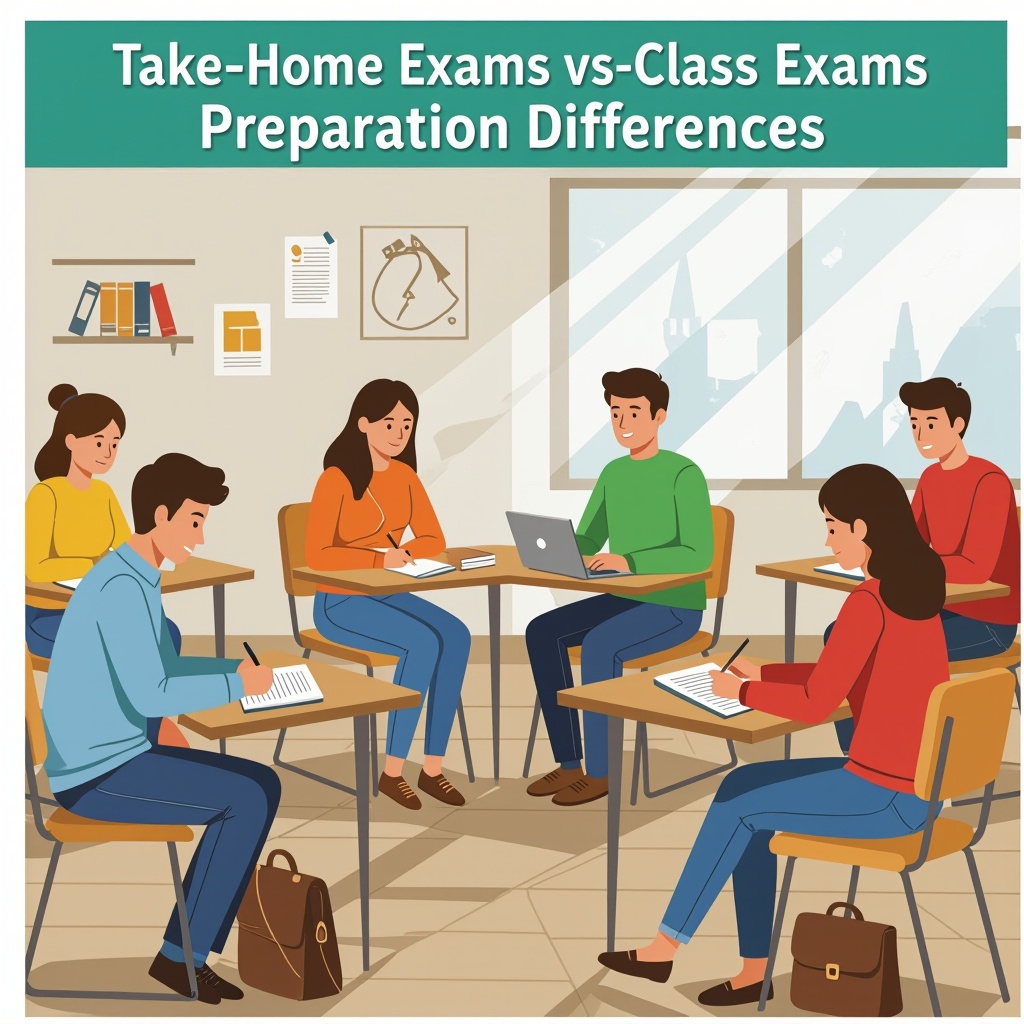
Depth of Learning and Study Strategies
In-class exams demand students master content in advance. The limitation of using external materials emphasizes memorization. This process often requires intense study sessions, focusing on absorbing facts and committing them to memory.
On the other hand, take-home exams provide a platform for deep learning by encouraging the application, analysis, and synthesis of information. Students develop critical thinking skills as they engage with the subject matter over a longer period. This type of assessment favors a more thoughtful and thorough approach, allowing learners to showcase higher-order cognition beyond simple recall.
A prominent educational expert once stated, “Take-home exams provide students the chance to apply their knowledge creatively and critically, moving beyond mere rote learning.” This quote highlights how take-home assessments offer opportunities for practical application and reflection, which are crucial learning tools.
To optimize study habits for take-home exams, I recommend:
- Allocating time to explore different perspectives.
- Encouraging connections between concepts.
- Practicing consistent review rather than last-minute cramming.
These strategies cultivate a deeper understanding and foster an ability to apply knowledge in various contexts.

Performance and Score Variability
Take-home exams often lead to higher average scores and reduced variability compared to in-class exams. For instance, the average score for take-home (online) exams is 84.44, with a standard deviation of 18.89. In contrast, in-person (online) exams have an average score of 66.89 and a standard deviation of 29.84. This difference indicates a notable performance gap favoring take-home formats.
The reduced standard deviation implies that scores are more consistent in take-home scenarios. Students benefit from less test anxiety, allowing them to perform at a level more representative of their understanding. The consistency in performance offers a more equitable assessment environment, minimizing external pressures that could sway results in a traditional exam setting. The implications are clear: take-home exams provide a platform for students to demonstrate their capabilities with more uniform outcomes.

Resource Utilization and Academic Integrity
Take-home exams encourage students to utilize a wide range of resources. With open-book access, students can leverage textbooks and online content to deepen their understanding. This approach can enhance learning and allows them to explore topics thoroughly.
Yet, there’s often concern about academic integrity. The risk of cheating rises with potential external help. To address this, exam design should focus on promoting independent thought. Here are some effective strategies for instructors to mitigate integrity issues:
- Use varied questions to minimize chances of cheating.
- Require detailed explanations for answers to demonstrate understanding.
- Limit collaboration by clarifying rules on open-book usage.
- Design assessments that emphasize critical thinking over rote memorization.
By implementing these strategies, instructors can maintain academic integrity while still taking advantage of resource accessibility.
Test Anxiety and Exam Environment
Take-home exams offer a flexible environment that can help reduce test anxiety. Unlike in-class exams, you have the freedom to manage your time. This flexibility allows you to use stress management techniques that suit your needs. Many students report experiencing reduced stress levels with take-home exams. For instance, Amy, a college senior, shared how she focuses better without the pressure of a timed setting. In contrast, the real-time pressure of in-class exams can hinder performance, particularly for those sensitive to stress. The structured environment, limited time, and constant invigilation can heighten anxiety. Reducing this stress is key for achieving better outcomes. Opting for take-home exams might provide the calm setting needed to excel.

Sources:
American Society for Engineering Education, “Combining Take-home and In-person Exams to Improve Student Performance and Improve Instructor Grading Efficiency”
University of Toronto, The Varsity, “Opinion: Take-home Exams Benefit Students in More Ways Than One”
MDPI, “Education Sciences”