

If you’re a HR or L&D professional studying in Dubai, Abu Dhabi, Sharjah, or anywhere across the UAE, you already know the CIPD qualification is one of the most respected credentials you can earn. You also know something else: the assignments are where most learners get stuck. Not because the content is impossible, but because they never learned how to structure a CIPD assignment the way assessors actually want it.
This guide breaks down the exact CIPD assignment structure for Level 3, Level 5, and Level 7 — with real examples, answer patterns, and the mistakes that quietly turn a “Pass” into a “Refer.” Whether you’re searching for CIPD assignment help in UAE or just trying to figure out how to write a CIPD assignment that clears the criteria the first time, this is the walkthrough competitors don’t spell out.
Why CIPD Assignments Feel Harder Than They Should
CIPD isn’t an exam-based qualification for most units. It’s assessed through written assignments mapped against assessment criteria (ACs). This is the single most important thing to understand.
Your assessor is not reading your assignment for a “story.” They are ticking boxes against learning outcomes. Every AC has a command verb — explain, analyse, evaluate, assess, justify — and each verb demands a specific depth of response. Most learners in the UAE fail not on knowledge, but on three things:
- Writing a beautiful essay that ignores the assessment criteria
- Answering at the wrong depth (describing when they should be evaluating)
- Missing referencing, word count, or evidence requirements
Once you fix the structure, the pass rate takes care of itself.
The Universal CIPD Assignment Structure (Works Across All Levels)
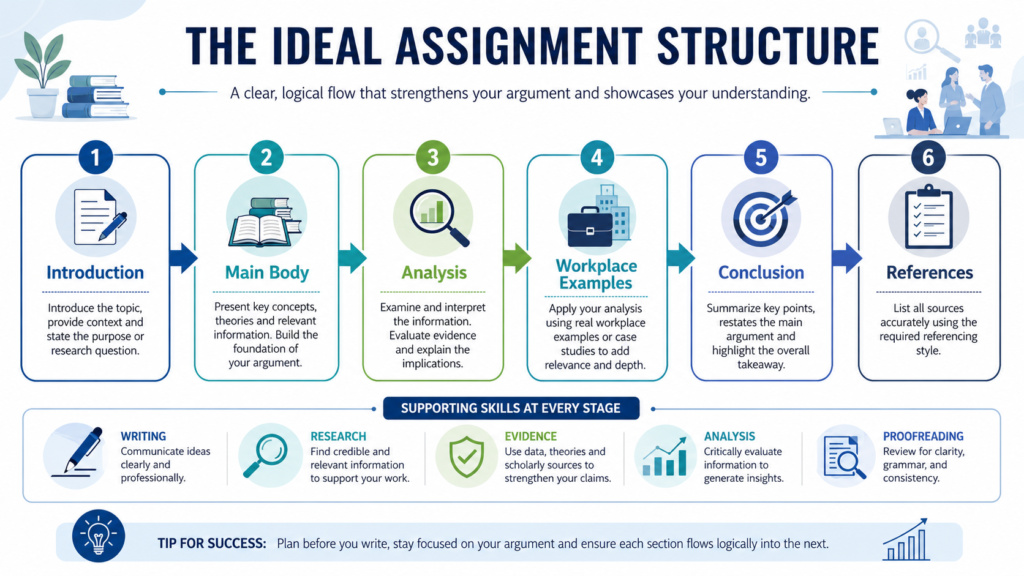
Before we split by level, here’s the skeleton that underpins every well-structured CIPD submission:
- Cover sheet — Your name, CIPD membership number, unit code, word count, and centre details.
- Introduction — Short. Set context, state what the assignment will address. Do not waste your word count here.
- Answer by Assessment Criteria (AC) — Structure your response AC by AC, using the AC number and command verb as your guide. This is the core.
- Application to your organisation — CIPD loves workplace context. Reference real UAE workplace examples where relevant.
- Conclusion / recommendations — Especially critical at Levels 5 and 7.
- Reference list — Harvard referencing, correctly formatted.
- Appendices (if allowed) — Supporting evidence that doesn’t count toward word count.
The golden rule: structure your assignment around the assessment criteria, not around a generic essay format. Use headings that mirror the AC. Assessors should be able to find each answer instantly.
CIPD Level 3 Assignment Structure (Foundation)
Who it’s for: New to HR/L&D, aspiring practitioners, or those supporting an HR function. Common searches: how to pass CIPD Level 3, CIPD Level 3 assignment examples.
At Level 3, command verbs stay descriptive: describe, explain, identify, list, give examples. You are demonstrating understanding, not deep critical analysis.
Structure for a Level 3 answer:
- State the point clearly (the “what”)
- Explain it (the “why” or “how”)
- Give a concrete example — ideally from a UAE workplace context
Example — AC 1.1: “Explain the knowledge, skills and behaviours required to be effective in an HR role.”
A well-structured answer names the specific KSBs (e.g. commercial awareness, ethical practice, active listening), explains why each matters to the role, and gives a short example of it in action — such as an HR officer in a Dubai retail firm using active listening during a grievance meeting.
Level 3 pass tips:
- Answer every single AC — a missed AC is an automatic refer.
- Keep it clear and practical. Over-writing here loses marks.
- Reference the CIPD Profession Map where relevant.
CIPD Level 5 Assignment Structure (Associate Diploma)
Who it’s for: Practising HR/L&D professionals, HR officers moving into management. Common searches: how to pass CIPD Level 5, CIPD Level 5 assignment help UAE, CIPD 5HR01 assignment example.
Level 5 is where the jump happens. Command verbs shift to analyse, assess, evaluate, compare. Description alone will get you referred. You must now show cause and effect, weigh options, and apply theory to practice.
Structure for a Level 5 answer (the A-E-A pattern):
- Assert — Make your point / present the concept or theory.
- Evidence — Support it with academic sources, models, or data (cite them).
- Apply & Analyse — Connect it to a real workplace, then analyse the impact — what happens as a result, what the trade-offs are.
Example — AC in 5HR01 (Employment Relationship Management): “Analyse the emerging developments in employment relations.”
A Pass-level answer doesn’t just list trends like remote work or Emiratisation policy. It analyses how, for example, UAE labour law reforms and Emiratisation targets are reshaping employer–employee expectations, then evaluates the implications for retention and workforce planning in a Gulf organisation.
Level 5 pass tips:
- Use models and theory, then critique them — don’t just describe.
- Every claim needs a citation. Harvard referencing is mandatory.
- Watch the word count (usually ±10%). Going under signals a shallow answer.
- Localise: UAE labour law, Emiratisation (Nafis), and Gulf workforce trends make your application stronger than generic Western examples.
CIPD Level 7 Assignment Structure (Advanced Diploma / Master’s Level)
Who it’s for: Senior HR professionals, HR managers, and those targeting Chartered Membership. Common searches: how to pass CIPD Level 7, CIPD Level 7 assignment help Dubai, CIPD 7 strategic assignment example.
Level 7 is postgraduate-level. Command verbs are the most demanding: critically evaluate, synthesise, justify, appraise, critically analyse. You are expected to engage with conflicting academic evidence, take a reasoned position, and defend it.
Structure for a Level 7 answer (the critical argument pattern):
- Position — State your argument or stance.
- Evidence from multiple sources — Draw on academic literature, including competing viewpoints.
- Critical evaluation — Weigh the strength of the evidence. Where do scholars disagree? What are the limitations?
- Justified conclusion — Take a defensible position and link it to strategic organisational impact.
Example — Level 7 (Strategic People Management): “Critically evaluate the contribution of HR to organisational performance.”
A Merit/Distinction answer engages with the debate between the “best practice” (universalist) and “best fit” (contingency) schools, cites competing evidence, acknowledges the limitations of linking HR directly to performance (causality problems), and then justifies a strategic position relevant to a specific organisational context — for instance, a multinational scaling operations in the GCC.
Level 7 pass tips:
- Depth of criticality is everything. “Critically evaluate” means engaging with disagreement, not summarising.
- Use recent, credible academic sources — not blogs. Peer-reviewed journals matter.
- Synthesise across sources rather than listing them one by one.
- Strategic lens: always connect back to organisational strategy and long-term impact.
Level 3 vs Level 5 vs Level 7: Structure at a Glance
| Element | Level 3 | Level 5 | Level 7 |
|---|---|---|---|
| Command verbs | Describe, explain, identify | Analyse, evaluate, assess | Critically evaluate, synthesise, justify |
| Depth | Understanding | Application + analysis | Critical argument |
| Theory use | Light, referenced | Applied and critiqued | Debated and synthesised |
| Referencing | Basic Harvard | Full Harvard, essential | Full Harvard, academic sources |
| Workplace application | Simple examples | Real analysis of impact | Strategic organisational impact |
The 7 Most Common Reasons CIPD Assignments Get Referred
If you’ve been referred — or want to avoid it — check your work against these:
- Ignoring the assessment criteria. You answered the question but not the AC.
- Wrong depth for the command verb. You described when you were asked to evaluate.
- No workplace application. CIPD is a practitioner qualification; theory alone isn’t enough.
- Weak or missing referencing. No citations, or wrong Harvard format.
- Word count breaches. Too far over or under the limit.
- Unsupported claims. Opinions with no evidence at Levels 5 and 7.
- Missing an AC entirely. One skipped criterion = refer, regardless of how good the rest is.
How to Write a CIPD Assignment That Passes First Time
Here’s the workflow that consistently works:
- Deconstruct the brief. List every AC and its command verb before you write a word.
- Build your structure around the ACs. Use them as your headings.
- Match your depth to the verb. Describe ≠ evaluate ≠ critically evaluate.
- Gather evidence early. Academic sources for theory, workplace examples for application.
- Write, then audit against the ACs. Ask: “Have I fully met this criterion?”
- Proofread and check referencing. Harvard style, consistent formatting.
- Check the word count. Stay within the allowed range.
Getting CIPD Assignment Help in the UAE
CIPD study is demanding, especially when you’re balancing a full-time HR role in Dubai or Abu Dhabi with coursework. If you’re searching for CIPD assignment help in UAE, CIPD writing support, or guidance on how to structure a CIPD assignment at any level, the goal should always be genuine understanding — knowing why an answer meets the criteria, so the skill sticks for your next unit and your career.
Use this structure, respect the command verbs, apply everything to a real workplace, and reference properly. Do that consistently, and the pass becomes predictable — at Level 3, Level 5, and Level 7 alike.
Frequently Asked Questions
How do I structure a CIPD assignment?
Structure it around the assessment criteria (ACs), not as a generic essay. Use each AC as a heading, match your depth to the command verb, apply theory to a real workplace, and reference in Harvard style.
How many words should a CIPD assignment be?
Word counts vary by unit and level, but you must stay within the allowed range (usually ±10%). Level 7 assignments are the longest and most demanding.
What’s the difference between CIPD Level 3, 5 and 7 assignments?
Level 3 tests understanding (describe/explain), Level 5 tests application and analysis (analyse/evaluate), and Level 7 tests critical, postgraduate-level argument (critically evaluate/synthesise).
Why do CIPD assignments get referred?
Most commonly: ignoring the assessment criteria, answering at the wrong depth, missing workplace application, weak referencing, or breaching the word count.
Can I get CIPD assignment help in the UAE?
Yes — support is widely available for learners in Dubai, Abu Dhabi, Sharjah and across the GCC. Choose help that builds your understanding rather than just handing you an answer.